Native Plants of Missouri
The native plants that belong in your yard: what to plant for pollinators, by zone, with bloom timing and a species table.
- Native species grouped by sun, soil, and wildlife value
- Bloom windows and pollinator host-plant pairings
- What belongs in your USDA zone
- A full species table you can take to the nursery
- Typical planting windows, month by month
$9.99one-time
Instant download · yours to keep, with no account and no renewal · full refund within 30 days
A look inside
What the Missouri pages actually look like
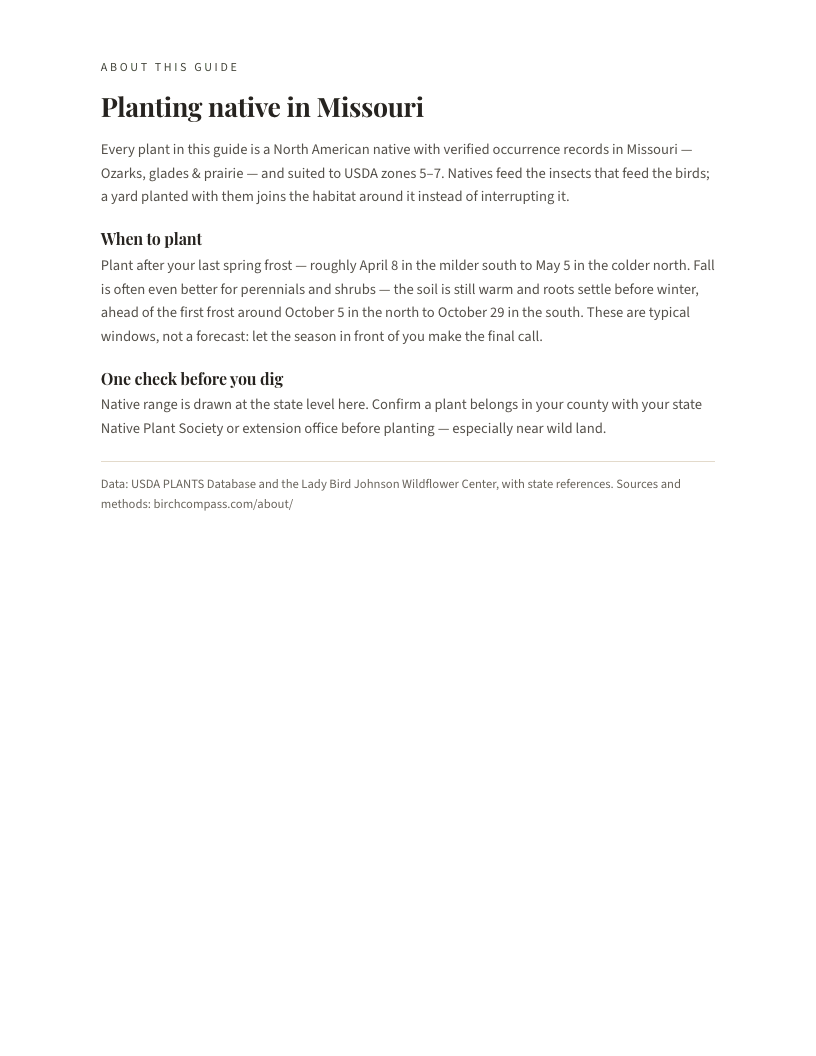
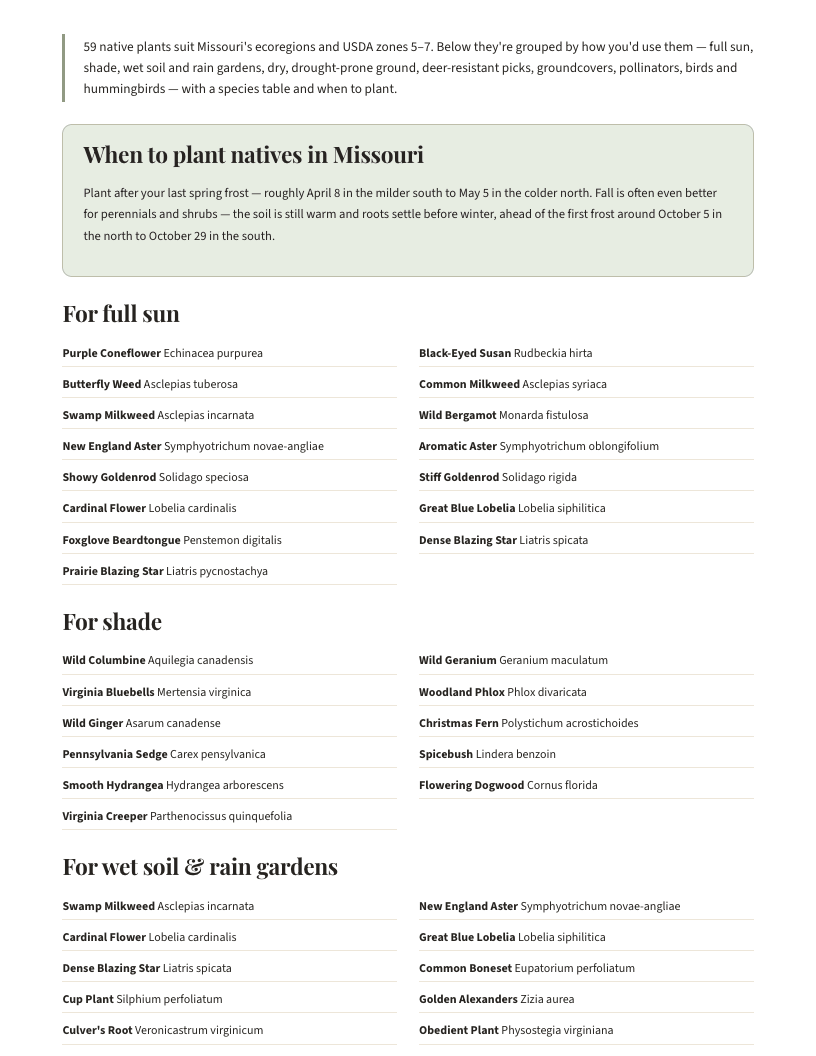
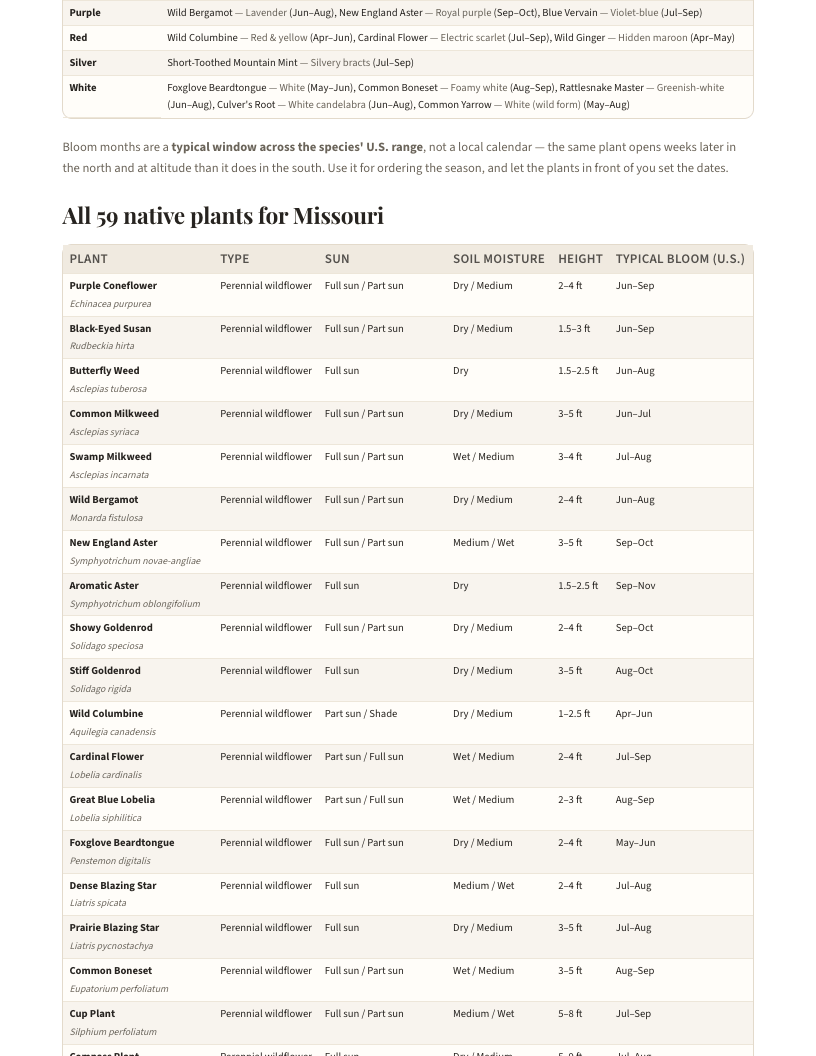
From the Missouri edition
Some of what is actually in it
59 native species are profiled for Missouri, chosen for hardiness zones 5a–7b. A dozen of them:
- Purple Coneflower
- Black-Eyed Susan
- Butterfly Weed
- Common Milkweed
- Swamp Milkweed
- Wild Bergamot
- New England Aster
- Aromatic Aster
- Showy Goldenrod
- Stiff Goldenrod
- Wild Columbine
- Cardinal Flower
How the Missouri year breaks down
Counted, not claimed
Something in the Missouri list is in bloom from March through November, and July is the peak: 28 of the 59 species are flowering then.
19 of them are caterpillar host plants and 20 support specialist bees: the ones that do the most work in Missouri yards.
In the box
Exactly what you receive
| Missouri pages | 10 pages: the species table, bloom windows and planting calendar |
|---|---|
| Format | PDF, laid out for both Letter and A4 |
| Delivery | An instant download link, plus a link you can re-open for 72 hours |
| Access | Yours to keep: no expiry, no account, no subscription |
| Refunds | Full refund within 30 days, no questions |
How it works
From checkout to the field
Buy it
Checkout takes a card and an email address: no account to create.
Open it straight away
The download link appears immediately and the Missouri files are yours to keep.
Use it through the year
Print the Missouri pages you want and take them outside; they are laid out with room to write on as the season moves.
Free and paid, side by side
The Missouri pages here stay free. Here is what the edition adds.
| The free Missouri pages | Native Plants of Missouri | |
|---|---|---|
| What it covers | The month Missouri is in, free and always | All twelve Missouri months, planned before they arrive |
| Garden timing | The notes for your zone, once the site knows it | Every Missouri zone from 5a–7b, side by side on the page |
| Where you can read it | On a screen, wherever Missouri has signal | On paper, in the field, with no signal at all |
| Price | Free, and staying that way | $9.99 once: no renewal, no account |
Before you buy
Who this is for
Made for
- Gardeners in Missouri planting for pollinators rather than for a catalogue
- Anyone replacing lawn with something that belongs here
- New Missouri gardeners who want the timing decided for them
Not for
- Anyone wanting exotic ornamentals; every species here is native to Missouri
- Precise planting dates: Missouri timing is given as windows
Everything here describes typical timing across Missouri, drawn from long-run records: weather, elevation and how close you are to water all move the real dates around. So the Missouri pages say "usually early May" and never "May 4th", which is not hedging but the most the data can honestly carry.
Where it comes from
Compiled from
USDA PLANTS Database · GBIF occurrence records · Lady Bird Johnson Wildflower Center · USA National Phenology Network · The Xerces Society · Cooperative Extension (land-grant directory). How each of these is used in the Missouri edition, and which figures are measured rather than modeled, is set out in the methodology.
Questions
Before you decide
Is this specific to Missouri, or a national guide with the name swapped in?
It is built from Missouri's own data. The 59 species in it were filtered to those with verified occurrence records in Missouri and to hardiness zones 5a–7b.
Missouri spans several hardiness zones, which one does this cover?
All of them. Missouri runs 5a–7b, and the guide carries each zone's timing rather than picking one and hoping it fits your garden.
How accurate is the timing for Missouri?
It describes typical timing across Missouri drawn from long-run records, and because weather, elevation and habitat move real Missouri dates around it says "usually early May" rather than "May 4th".
Is it worth paying when the Missouri pages here are free?
The free Missouri pages are the month you are in; this is the whole Missouri year, planned before it arrives and printable, so you are not holding a screen in the garden.
Will it work for my part of Missouri, or just the big cities?
It is written at state resolution: Missouri as a whole, with regional notes where Missouri genuinely differs end to end, and nothing behind it is recorded finely enough to honestly promise more than that.
What format is the Missouri edition, and can I print it?
A PDF laid out for both Letter and A4, one page per sheet: printing it is the point, since the Missouri pages are made to be carried outside.
What if the Missouri guide is not what I expected?
Email hello@birchcompass.com within 30 days for a full refund on the Missouri edition, and keep the files either way: asking for them back would be theatre.
Prefer to read online first? The free Missouri native plants reference covers the same ground on screen.
The rest of the Missouri shelf
Also for Missouri
Missouri Nature Year 2027
Everything Birch Compass knows about a year of nature in one state: the book, the posters, the sky calendar, the…
$34.00
The Missouri Set
Three printable Missouri editions in one purchase: the twelve-month journal, the native plants reference and the…
$29.00
Missouri Nature Year 2027 + Journal
The complete Missouri Nature Year with the undated journal beside it: everything the site knows about the year, and…
$42.00
The Missouri Nature Journal
Twelve printable month pages: a reference side built from public nature data for your state, and a field-notes side…
$14.00
Birds of Missouri
The state's most-recorded birds, ranked from survey data, with when each is present through the year and a life list…
Not on sale yet