Zone 8 Planting Planner
The whole gardening year for one USDA zone, in windows rather than dates.
- Every task in its window, ordered through the year
- Frost dates for the zone, stated as ranges not promises
- Start-indoors, transplant, and direct-sow timing
- What to do in the dormant months
- One planner, any state in the zone
$9.00one-time
Instant download · yours to keep, with no account and no renewal · full refund within 30 days
A look inside
What the Zone 8 Planting Planner pages actually look like
Zone 8, task by task
What the planner actually tells you to do
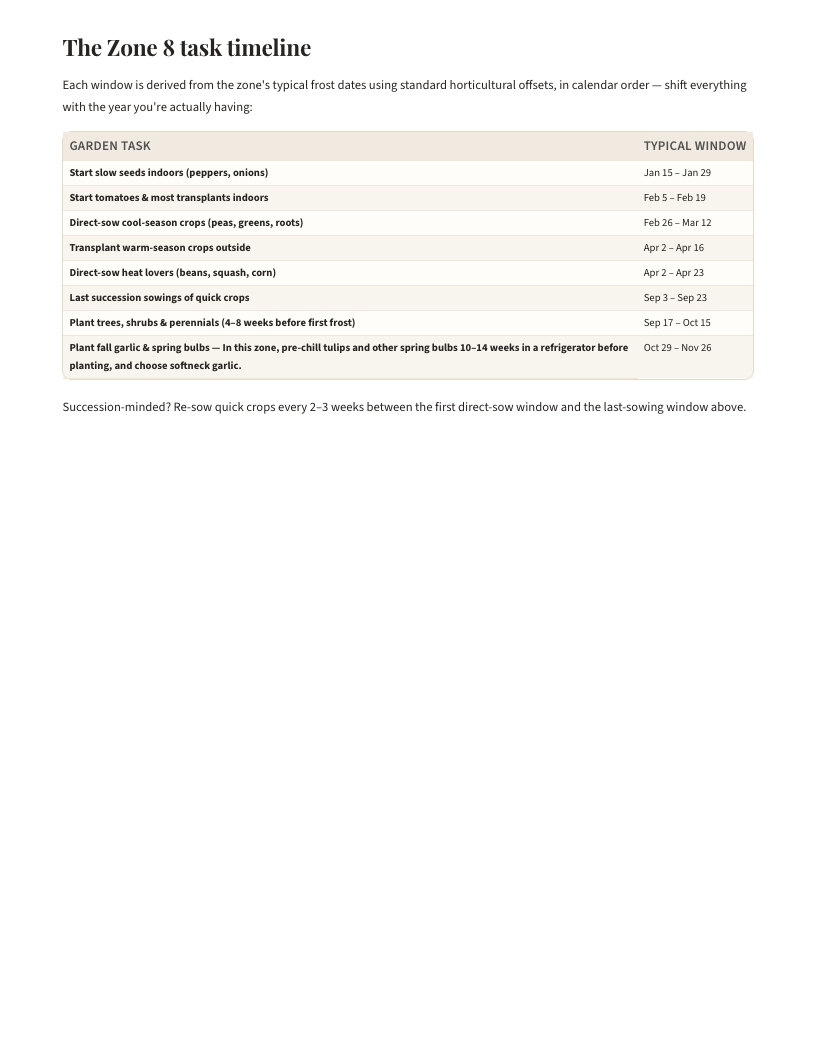
| Start slow seeds indoors (peppers, onions) | Jan 15 – Jan 29 |
|---|---|
| Start tomatoes & most transplants indoors | Feb 5 – Feb 19 |
| Direct-sow cool-season crops (peas, greens, roots) | Feb 26 – Mar 12 |
| Transplant warm-season crops outside | Apr 2 – Apr 16 |
| Direct-sow heat lovers (beans, squash, corn) | Apr 2 – Apr 23 |
| Last succession sowings of quick crops | Sep 3 – Sep 23 |
| Plant trees, shrubs & perennials (4–8 weeks before first frost) | Sep 17 – Oct 15 |
| Plant fall garlic & spring bulbs: In this zone, pre-chill tulips and other spring bulbs 10–14 weeks in a refrigerator before planting, and choose softneck garlic. | Oct 29 – Nov 26 |
The two anchors
Where zone 8's year turns
| Last spring frost | March 26, typically: every spring task is placed against it |
|---|---|
| First fall frost | November 12, typically: every autumn task counts back from it |
How zone 8 is planned
Counted, not claimed
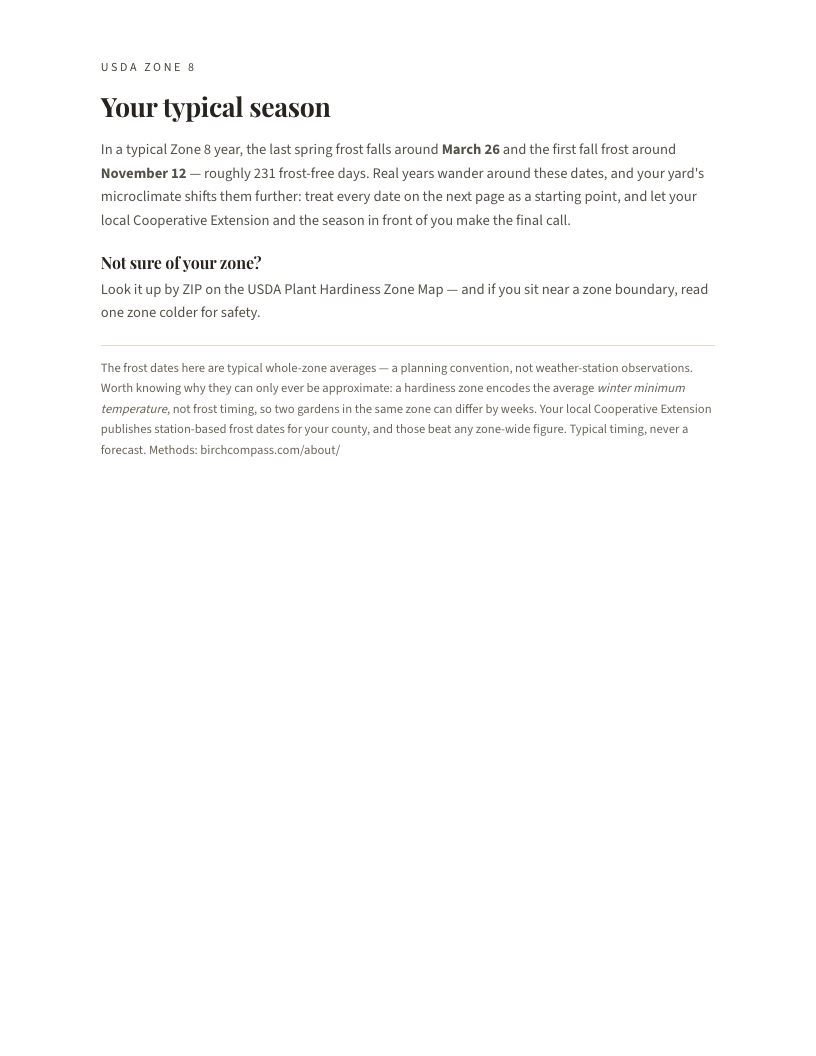
Zone 8 works from two anchors: a typical last spring frost and a typical first fall frost. Every task in the planner is placed relative to those, as a window, so it stays true whichever way the year runs early or late.
It is one planner for every state that contains zone 8: the plants and the timing follow the zone, which is what actually governs them, rather than a state border.
How it works
From checkout to the field
Buy it
Checkout takes a card and an email address: no account to create.
Open it straight away
The download link appears immediately and the zone 8 planner is yours to keep.
Use it through the year
Work down the windows through the season: it is ordered so the next thing to do is always the next thing on the page.
Free and paid, side by side
What the edition adds to what is already free here
| On the site | Zone 8 Planting Planner | |
|---|---|---|
| What it covers | This month's jobs, on the site | The whole gardening year for zone 8, ordered start to finish |
| How timing is given | The current window | Every window in sequence, so you can see what is coming |
| Where it works | Wherever you are | Any state that contains zone 8 |
| Price | Free, and staying that way | $9.00 once: no renewal |
Before you buy
Who this is for
Made for
- Gardeners in zone 8 who want the year sequenced rather than guessed
- Anyone who has moved zones and no longer trusts their old instincts
- People starting seeds indoors who need the count-back done for them
Not for
- Anyone wanting exact calendar dates: zone 8 timing is given as windows
- Gardeners after a species list; this planner is about timing, not what to buy
Frost dates here are typical whole-zone averages, and a zone stretches across a great deal of country. Use them to order the season, and let the weather in front of you set the exact day.
Questions
Before you decide
How do I know I am in zone 8?
Your USDA hardiness zone comes from your average coldest winter temperature. Enter a ZIP anywhere on this site and it will tell you, on your own device.
My yard runs warmer than zone 8: is it still useful?
Yes, and that is why everything is a window rather than a date. A sheltered yard runs early inside its window; an exposed one runs late. The order of the tasks does not change.
Does one planner really cover several states?
It covers zone 8, which is what actually governs when things can go in the ground. A state line does not change a frost date; an elevation change does.
What format is it, and can I print it?
A PDF laid out for both Letter and A4, one page per sheet. Printing it is the point: a gardening year is meant to be used away from a screen.
What if it is not what I expected?
Email hello@birchcompass.com within 30 days for a full refund, and keep the files either way: asking for them back would be theatre.
In the box
Exactly what you receive
| Pages | 4 pages: the whole gardening year in windows |
|---|---|
| Format | PDF, laid out for both Letter and A4 |
| Delivery | An instant download link, plus a link you can re-open for 72 hours |
| Access | Yours to keep: no expiry, no account, no subscription |
| Refunds | Full refund within 30 days, no questions |
Where it comes from
Compiled from
USDA Plant Hardiness Zone Map · Cooperative Extension (land-grant directory). How each of these is used in the national edition, and which figures are measured rather than modeled, is set out in the methodology.
Not tied to one state
Others like this

The 2027 Sky Year
Every meteor shower and moon phase of 2027, with the moon's brightness computed for each peak, so you know which…
$10.00
Zone 7 Planting Planner
The whole gardening year for one USDA zone, in windows rather than dates.
$9.00
Zone 9 Planting Planner
The whole gardening year for one USDA zone, in windows rather than dates.
$9.00
Everything else here is built state by state: pick yours from the shelf.